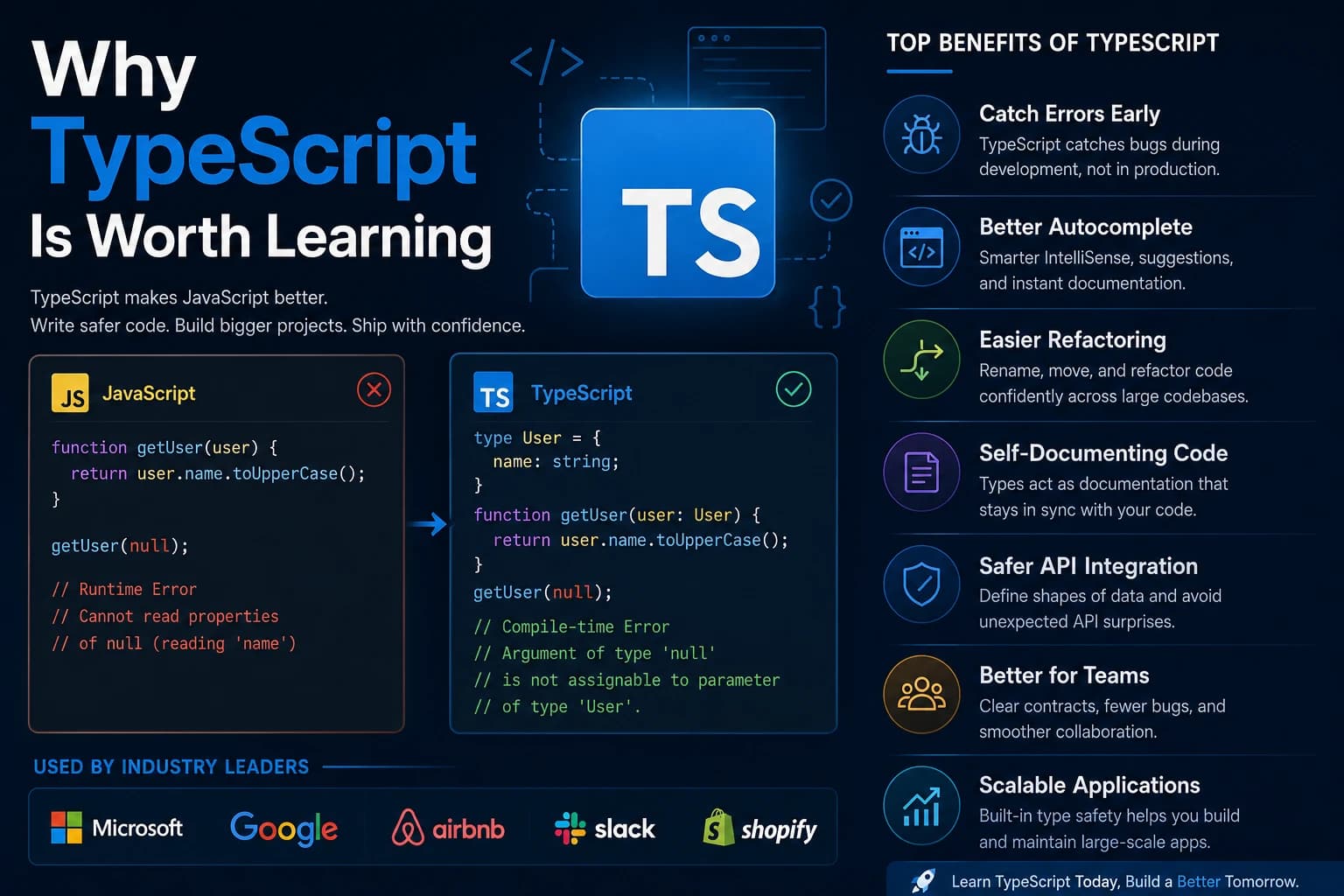
Why TypeScript Is Worth Learning (Even If You Already Know JavaScript)
JavaScript has powered the web for nearly three decades, and it's still one of the most versatile programming languages available. From interactive websites to backend servers, mobile apps, and desktop applications, JavaScript is everywhere. So, if JavaScript is already so powerful, why are so many companies and developers choosing TypeScript?
The answer is simple: TypeScript helps you write better JavaScript.
Whether you're building a small personal project or a large-scale application with thousands of files, TypeScript makes your code more reliable, easier to maintain, and significantly less prone to bugs.
Let's explore why learning TypeScript is one of the best investments you can make as a developer.
What Is TypeScript?
TypeScript is an open-source programming language developed by Microsoft that builds on top of JavaScript. It adds static typing, modern language features, and powerful developer tooling while remaining fully compatible with JavaScript.
Unlike JavaScript, TypeScript checks your code during development and warns you about potential errors before your application ever runs.
Think of it as having a smart assistant that reviews your code every time you write it.
1. Catch Bugs Before They Reach Production
One of JavaScript's greatest strengths is its flexibility—but that flexibility can also lead to unexpected runtime errors.
Consider this example:
function greet(user) {
    return user.name.toUpperCase();
}

greet(null);
This code runs without any warning until it crashes at runtime.
With TypeScript, the compiler immediately points out the problem, allowing you to fix it before deploying your application.
Finding bugs during development is far less expensive than discovering them after your users do.
2. Better Autocomplete and IntelliSense
Modern IDEs become significantly more powerful when using TypeScript.
Instead of guessing available properties or searching through documentation, your editor can provide:
- Intelligent autocomplete
- Function signatures
- Parameter hints
- Type information
- Instant error detection
This improves productivity and reduces context switching while coding.
3. Easier Refactoring
As applications grow, renaming variables, moving functions, or restructuring code becomes increasingly risky.
In plain JavaScript, it's easy to accidentally break something without realizing it.
TypeScript understands your codebase, allowing your editor to safely:
- Rename variables
- Update interfaces
- Move files
- Detect broken references
Large-scale refactoring becomes much less stressful.
4. Self-Documenting Code
Good code should be easy to understand.
Instead of guessing what a function expects, TypeScript makes the intent explicit.
For example:
type User = {
    id: number;
    name: string;
    email: string;
};

function createUser(user: User) {
    // ...
}
Even without additional documentation, another developer immediately knows what data the function expects.
Types become living documentation that stays synchronized with your code.
5. Build Large Applications with Confidence
Small projects may not reveal JavaScript's weaknesses.
But once your application grows to hundreds of components and thousands of lines of code, maintaining consistency becomes much more difficult.
TypeScript helps teams by:
- Enforcing consistent data structures
- Preventing accidental changes
- Reducing runtime errors
- Improving collaboration
This is one of the primary reasons companies like Microsoft, Google, Airbnb, Slack, and Shopify rely heavily on TypeScript.
6. Safer API Integration
APIs are one of the most common sources of bugs.
Imagine expecting this response:
{
    "name": "John",
    "age": 25
}
But the server suddenly returns:
{
    "username": "John"
}
Without type checking, your application may fail unexpectedly.
With TypeScript, these inconsistencies are caught during development, making integrations much more reliable.
7. Makes React Development Better
TypeScript has become the standard for many React projects.
It helps with:
- Component props
- State management
- Hooks
- Context API
- Custom hooks
- Event handling
Instead of guessing which props a component accepts, TypeScript provides immediate feedback.
This leads to more reusable and reliable components.
8. Improves Team Collaboration
In a team environment, multiple developers work on the same codebase.
Without clear contracts, misunderstandings happen frequently.
TypeScript creates a shared understanding by defining exactly:
- What a function accepts
- What it returns
- Which properties exist
- Which values are optional
This reduces communication overhead and prevents integration issues.
9. Learn Better Programming Practices
TypeScript encourages developers to think more carefully about software design.
You'll naturally become better at:
- Designing interfaces
- Modeling data
- Writing reusable functions
- Handling edge cases
- Avoiding null-related bugs
These skills improve your overall engineering ability—not just your TypeScript knowledge.
10. Industry Adoption Keeps Growing
TypeScript is no longer a niche technology.
Today it's widely used across startups and enterprise organizations alike.
Many modern frameworks now recommend or even default to TypeScript, including:
- Next.js
- Angular
- NestJS
- React Native
- Vue
- Astro
Learning TypeScript significantly expands your career opportunities.
Does TypeScript Replace JavaScript?
No.
Every TypeScript application eventually becomes JavaScript.
TypeScript simply adds an additional layer of safety and developer tooling before your code runs.
If you already know JavaScript, learning TypeScript feels like adding superpowers to a language you already use every day.
Is TypeScript Hard to Learn?
Not at all.
If you're comfortable with modern JavaScript, you can start by learning:
- Basic types
- Interfaces
- Type aliases
- Functions
- Generics
- Enums (optional)
- Utility types
You don't need to master every advanced feature immediately.
Most developers become productive with TypeScript after just a few weeks of consistent practice.
Final Thoughts
TypeScript isn't about replacing JavaScript—it's about making JavaScript more predictable, maintainable, and scalable.
For small experiments, JavaScript may be enough. But as your applications grow, TypeScript helps you catch mistakes early, improve collaboration, and build software with greater confidence.
Whether you're building a personal portfolio, a SaaS product, or an enterprise application, TypeScript provides the tools to write cleaner, safer, and more maintainable code.
If you're serious about becoming a modern full-stack developer, learning TypeScript isn't just a good idea—it's one of the most valuable skills you can add to your toolkit.