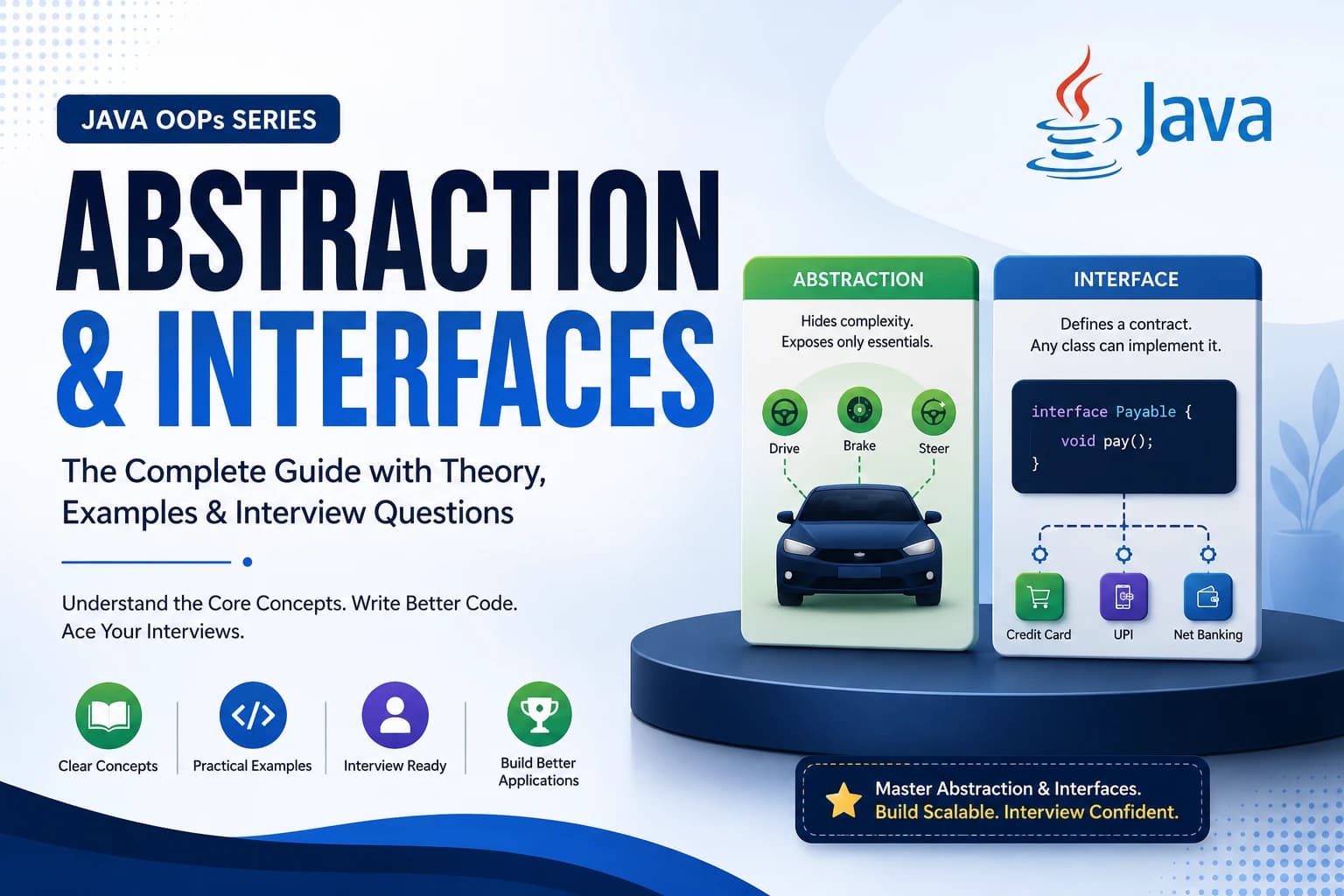
Mastering Abstraction and Interfaces in Java
The Complete Guide with Theory, Real-World Examples, Code Examples & Interview Questions
Introduction
Imagine you're driving a car.
To start the car, you simply press a button or turn a key.
You don't need to know:
- How the engine ignites the fuel
- How the pistons move
- How the transmission shifts gears
- How electricity flows through hundreds of components
All you need to know is what to do, not how it happens internally.
This is exactly the idea behind Abstraction.
Abstraction is one of the four pillars of Object-Oriented Programming (OOP), and it plays a crucial role in designing scalable, maintainable, and secure applications.
In Java, abstraction is achieved primarily through:
- Abstract Classes
- Interfaces
Although they may seem similar, they serve different purposes and are used in different scenarios.
By the end of this guide, you'll understand not only the syntax but also the reasoning behind abstraction, when to use abstract classes or interfaces, and how they're applied in real-world software development.
What is Abstraction?
Definition
Abstraction is the process of hiding unnecessary implementation details while exposing only the essential features of an object.
In other words, abstraction focuses on what an object can do rather than how it does it.
The internal implementation is hidden from the user, reducing complexity and making software easier to use and maintain.
Breaking Down the Definition
Consider a television remote.
You press the Power button.
The remote sends infrared signals, which are interpreted by the television's receiver, triggering the power supply, initializing hardware, and displaying the screen.
As a user, you don't need to understand any of these internal processes.
You only need one operation:
Power ON
This is abstraction.
The complexity is hidden, while the essential functionality is exposed.
Why Do We Need Abstraction?
Without abstraction, software becomes difficult to use and maintain.
Imagine if Java required you to know how memory allocation works every time you created an object.
Instead of writing:
Student student = new Student();
you might have to manually allocate memory, initialize variables, and manage cleanup.
Abstraction allows developers to work at a higher level, focusing on business logic rather than low-level implementation details.
Advantages of Abstraction
- Reduces complexity
- Improves readability
- Hides sensitive implementation details
- Makes code easier to maintain
- Encourages modular design
- Allows implementation changes without affecting users
- Improves scalability
Real-Life Examples of Abstraction
ATM Machine
When using an ATM, you can:
- Withdraw money
- Deposit money
- Check your balance
You cannot directly access the bank's database.
The ATM provides only the operations you need while hiding the internal banking system.
Mobile Phone
You tap the camera icon.
Behind the scenes, the phone:
- Initializes hardware
- Allocates memory
- Focuses the lens
- Adjusts exposure
- Processes the image
The user only sees:
Take Photo
Car
You use:
- Accelerator
- Brake
- Steering Wheel
You don't interact directly with:
- Fuel injectors
- Gearbox
- Engine Control Unit
- Cooling System
How is Abstraction Achieved in Java?
Java provides two mechanisms:
- Abstract Classes
- Interfaces
Both help hide implementation details, but they serve different purposes.
Abstract Class
Definition
An abstract class is a class that cannot be instantiated and is designed to act as a base class for other classes.
It may contain:
- Abstract methods
- Concrete methods
- Variables
- Constructors
- Static methods
- Final methods
An abstract class represents a partially implemented blueprint.
Why Use an Abstract Class?
Suppose you're designing software for animals.
Every animal:
- Eats
- Sleeps
But different animals make different sounds.
Instead of forcing the parent class to define every sound, we leave that responsibility to the child classes.
Example
abstract class Animal {

    void eat() {
        System.out.println("Animal is eating.");
    }

    abstract void sound();
}
Child Class
class Dog extends Animal {

    @Override
    void sound() {
        System.out.println("Dog barks.");
    }
}
Using the Class
public class Main {

    public static void main(String[] args) {

        Animal animal = new Dog();

        animal.eat();
        animal.sound();

    }

}
Output
Animal is eating.
Dog barks.
Notice that the eat() method is shared, while sound() is implemented differently.
Abstract Method
Definition
An abstract method is a method declared without a body.
Syntax
abstract void display();
The child class must implement it unless the child is also abstract.
Rules for Abstract Classes
An abstract class:
- Cannot be instantiated
- Can contain constructors
- Can have both abstract and concrete methods
- Can contain static methods
- Can contain final methods
- Can have member variables
- May contain zero abstract methods (though uncommon)
Can an Abstract Class Have a Constructor?
Yes.
Many beginners think abstract classes cannot have constructors because objects cannot be created from them.
However, when a child object is created, the abstract class constructor executes first.
Example
abstract class Animal {

    Animal() {
        System.out.println("Animal constructor");
    }

}
class Dog extends Animal {

    Dog() {
        System.out.println("Dog constructor");
    }

}
Output
Animal constructor
Dog constructor
Can We Create an Object of an Abstract Class?
No.
This is invalid.
Animal animal = new Animal();
Reason:
The class is incomplete because it may contain abstract methods without implementation.
Interface
Definition
An interface is a blueprint that defines a contract for classes.
It specifies what a class should do, but not how it should do it.
Every class implementing an interface agrees to provide implementations for its methods.
Real-Life Example
Imagine a USB port.
Every USB device must follow the USB standard.
Whether it's:
- Keyboard
- Mouse
- Printer
- Webcam
the computer knows how to communicate because each device follows the same contract.
Interfaces work exactly like this.
Basic Interface Example
interface Payment {

    void pay();

}
Implementation
class CreditCard implements Payment {

    @Override
    public void pay() {
        System.out.println("Payment using Credit Card");
    }

}
Another implementation
class UPI implements Payment {

    @Override
    public void pay() {
        System.out.println("Payment using UPI");
    }

}
Usage
Payment payment = new CreditCard();

payment.pay();
Later, you can switch to:
payment = new UPI();

payment.pay();
Without changing the calling code.
Why Use Interfaces?
Interfaces provide:
- Loose coupling
- Flexibility
- Multiple inheritance of behavior
- Easier testing
- Better scalability
- Plug-and-play architecture
This is why frameworks like Spring Boot rely heavily on interfaces.
Java 8 Interface Features
Before Java 8, interfaces could contain only abstract methods.
Java 8 introduced:
Default Methods
interface Vehicle {

    default void start() {
        System.out.println("Vehicle Started");
    }

}
Default methods allow adding new functionality without breaking existing implementations.
Static Methods
interface MathUtility {

    static int square(int x) {
        return x * x;
    }

}
Usage
MathUtility.square(5);
Java 9 Interface Features
Java 9 introduced private methods.
interface Example {

    private void display() {
        System.out.println("Private");
    }

}
Private methods help reuse logic within the interface itself.
Abstract Class vs Interface
Abstract ClassInterfaceUses extendsUses implementsCan have constructorsNo constructorsCan have instance variablesOnly public static final constantsSupports partial implementationDefines a contractSingle inheritanceMultiple interfaces can be implementedSuitable for closely related classesSuitable for unrelated classes sharing behavior
When Should You Use an Abstract Class?
Use an abstract class when:
- Classes share common code.
- You want to provide default implementations.
- Objects share state (fields).
- There is an IS-A relationship.
Example:
Animal

↓

Dog

↓

Cat

↓

Lion
When Should You Use an Interface?
Use an interface when:
- Different classes need the same capability.
- Classes are unrelated.
- You want loose coupling.
- Multiple implementations are expected.
Example:
Printer

Scanner

Camera

↓

Printable
These devices aren't related by inheritance but can all implement a Printable interface if appropriate.
Can an Abstract Class Implement an Interface?
Yes.
Example
interface Payment {

    void pay();

}
abstract class OnlinePayment implements Payment {

}
Since the abstract class is still incomplete, it doesn't have to implement pay().
Can an Interface Extend Another Interface?
Yes.
interface A {

    void display();

}

interface B extends A {

    void print();

}
Can a Class Implement Multiple Interfaces?
Yes.
interface Camera {

    void click();

}

interface Music {

    void play();

}

class Phone implements Camera, Music {

    public void click() {}

    public void play() {}

}
This is how Java supports multiple inheritance of type safely.
What Happens If Two Interfaces Have the Same Default Method?
Example
interface A {

    default void show() {
        System.out.println("A");
    }

}

interface B {

    default void show() {
        System.out.println("B");
    }

}
class Demo implements A, B {

    @Override
    public void show() {
        A.super.show();
    }

}
The class must override the conflicting method to resolve ambiguity.
Best Practices
- Use interfaces to define capabilities.
- Use abstract classes for shared implementation.
- Don't create abstract classes with only abstract methods unless there's a clear design reason.
- Prefer interfaces when designing APIs.
- Keep interfaces focused on a single responsibility.
Frequently Asked Interview Questions
1. What is abstraction in Java?
Abstraction is the process of hiding implementation details while exposing only the essential functionality.
2. How is abstraction achieved in Java?
Using:
- Abstract classes
- Interfaces
3. Can an abstract class have constructors?
Yes.
Constructors are executed when a subclass object is created.
4. Can an abstract class have concrete methods?
Yes.
An abstract class can contain both abstract and concrete methods.
5. Can an abstract class exist without abstract methods?
Yes.
Such classes are often used to prevent direct instantiation while still providing common functionality.
6. Can we instantiate an abstract class?
No.
Abstract classes are incomplete and cannot be instantiated directly.
7. Can an interface have constructors?
No.
Interfaces cannot be instantiated, so constructors are not allowed.
8. Can an interface have variables?
Yes, but every variable is implicitly:
public static final
Example
interface AppConfig {

    int MAX_USERS = 100;

}
Equivalent to:
public static final int MAX_USERS = 100;
9. Can an interface have implemented methods?
Yes.
- Default methods (Java 8)
- Static methods (Java 8)
- Private methods (Java 9)
10. Which is better: Abstract Class or Interface?
Neither is universally better.
Use:
- Abstract Class when classes share implementation and state.
- Interface when defining capabilities or contracts across unrelated classes.
Choosing the right one depends on the design requirements.
Key Takeaways
- Abstraction hides complexity and exposes only essential behavior.
- Abstract classes are ideal for sharing code and state among closely related classes.
- Interfaces define contracts and enable loose coupling between components.
- Modern Java interfaces can include default, static, and private methods.
- Prefer interfaces for flexibility and extensibility, and abstract classes when common implementation needs to be shared.
- Understanding when to use each is an essential skill for writing clean, maintainable, and scalable Java applications.