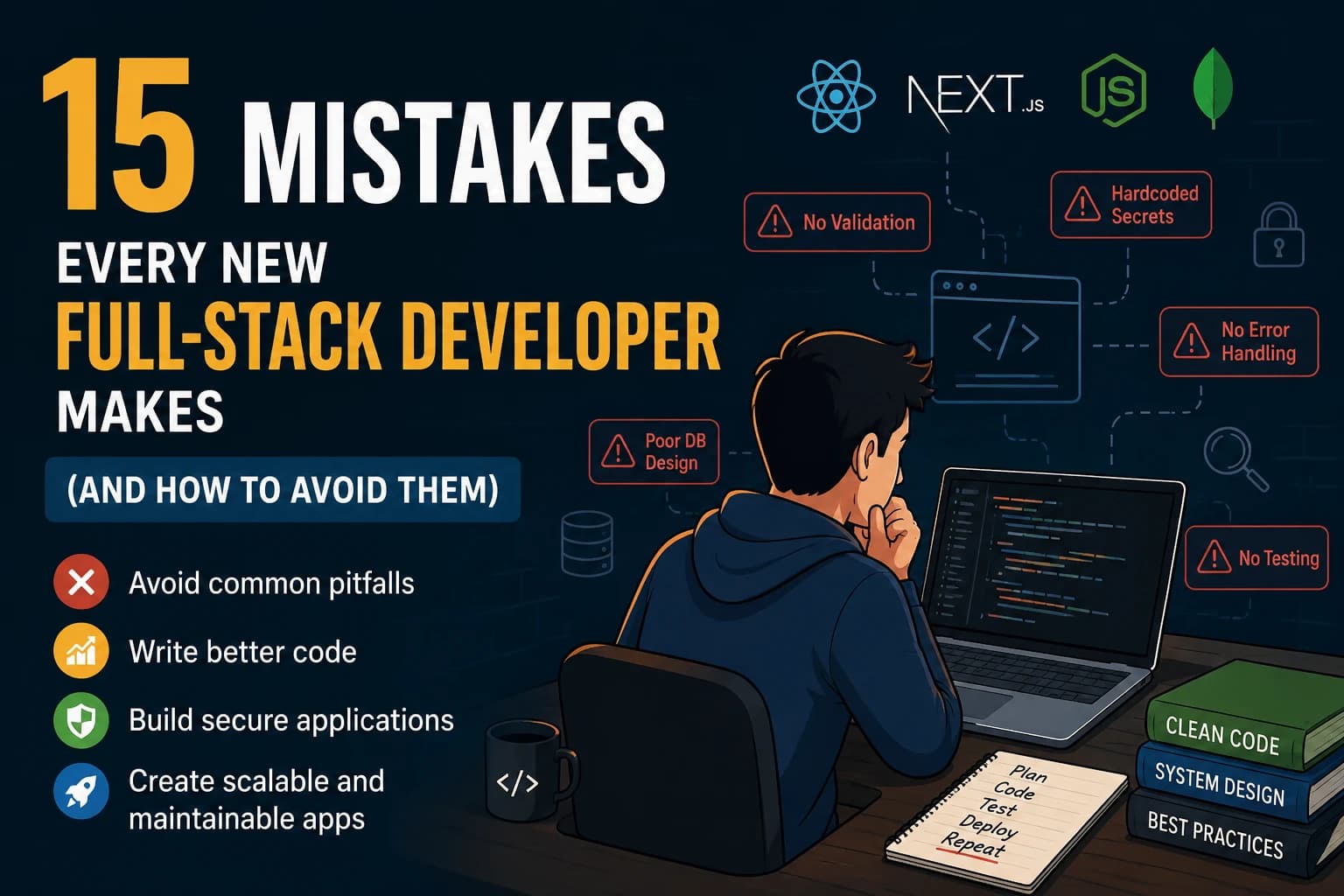
15 Mistakes Every New Full-Stack Developer Makes (And How to Avoid Them)
Being a full-stack developer isn't just about knowing React, Node.js, or databases. It's about making engineering decisions that keep applications maintainable, secure, and scalable. Most beginners make the same mistakes—not because they're careless, but because tutorials rarely teach production practices.
Here are 15 mistakes I've seen repeatedly and the lessons that can save you weeks (or even months) of debugging.
1. Jumping Straight Into Coding Without Planning
Many developers open VS Code and start building immediately. It feels productive, but it often leads to rewriting large parts of the application later.
Before writing a single line of code, spend some time answering:
- What problem does the application solve?
- Who are the users?
- What features are essential?
- How will the database be structured?
A simple whiteboard sketch or flowchart can prevent hours of unnecessary work.
2. Ignoring Database Design
A poorly designed database becomes difficult to maintain as the application grows.
Common issues include:
- Duplicate data
- Missing relationships
- No indexing
- Inconsistent naming
Instead of rushing into creating collections or tables, think about how your data relates.
Good database design is one of the biggest performance improvements you can make.
3. Putting Everything in One File
Many beginners end up with:
server.js
containing
- routes
- controllers
- database logic
- authentication
- business logic
A better structure looks like:
src/
│
├── controllers/
├── services/
├── routes/
├── middleware/
├── models/
├── utils/
├── config/
└── app.js
Your future self will thank you.
4. Trusting User Input
Never assume the data coming from the frontend is correct.
Instead of accepting everything:
{
  "age": -50,
  "email": "hello",
  "price": "free"
}
Validate every request.
Use libraries like:
- Zod
- Joi
- Yup
- Express Validator
Validation improves security and prevents unexpected crashes.
5. Hardcoding Secrets
Never commit this:
JWT_SECRET=mysecret123
DATABASE_URL=password123
API_KEY=abcdef
Use environment variables instead.
.env
Also:
- Never push .env files to GitHub.
- Add .env to .gitignore.
- Rotate leaked keys immediately.
6. Ignoring Error Handling
A lot of beginners write:
const user = await User.findById(id);
without handling failures.
What if:
- Database is offline?
- ID is invalid?
- User doesn't exist?
Good applications fail gracefully.
Return meaningful responses instead of exposing stack traces.
7. Writing Giant React Components
A component shouldn't be 700 lines long.
Instead of:
Dashboard.jsx
doing everything
Split into:
Dashboard
├── Sidebar
├── Navbar
├── Stats
├── Chart
├── RecentActivity
└── Footer
Small components are easier to test and reuse.
8. Not Learning Git Properly
Many developers only know:
git add .
git commit
git push
Git is much more than that.
Learn:
- branching
- merging
- rebasing
- cherry-picking
- stash
- resolving conflicts
These skills are essential when working in teams.
9. Skipping Authentication Best Practices
Authentication is more than logging users in.
Avoid:
- storing passwords in plain text
- long-lived tokens
- weak passwords
Instead:
- Hash passwords.
- Use secure cookies where appropriate.
- Implement refresh tokens if needed.
- Protect sensitive routes.
Security should never be an afterthought.
10. Forgetting About Performance
Everything works perfectly…
until 10,000 users arrive.
Performance improvements include:
- pagination
- lazy loading
- caching
- image optimization
- code splitting
- database indexes
Performance isn't just about speed—it also reduces infrastructure costs.
11. Never Writing Tests
Many developers think:
"I'll test it manually."
That works for small projects.
Large applications need automated testing.
Start simple:
- unit tests
- API tests
- integration tests
Testing catches bugs before your users do.
12. Building Projects Without Real Users
Tutorial projects rarely expose real-world problems.
Instead of cloning another Todo App, build something people can actually use.
Examples:
- Expense tracker
- Project management tool
- AI note-taking app
- Learning platform
- Habit tracker
Real users provide the best feedback.
13. Copy-Pasting Code Without Understanding It
Stack Overflow and AI tools are excellent resources—but blindly copying code can introduce bugs, security issues, and technical debt.
Before using any snippet, ask yourself:
- Why does this work?
- What problem is it solving?
- Are there trade-offs?
- Can I explain it to someone else?
Understanding beats memorization every time.
14. Neglecting Documentation
Six months later, even your own code can feel unfamiliar.
Good documentation should include:
- Project setup instructions
- Environment variables
- API endpoints
- Folder structure
- Deployment steps
A clear README can save hours of confusion for both you and your teammates.
15. Chasing Every New Framework
Every week there's a new framework, library, or trend promising to be the future.
Instead of constantly switching technologies, focus on mastering the fundamentals:
- JavaScript
- HTTP
- Databases
- APIs
- Networking
- Security
- System Design
Frameworks evolve, but solid engineering principles remain valuable throughout your career.
Final Thoughts
Every experienced developer has made many of these mistakes. They're part of the learning process. The goal isn't to avoid every misstep—it's to recognize them early and build better habits over time.
A great full-stack developer isn't defined by the number of frameworks they know. They're defined by the quality of the systems they build, the problems they solve, and the reliability of the code they leave behind.
The sooner you adopt production-minded practices, the easier it becomes to build applications that are not only functional but also maintainable, secure, and ready to scale.