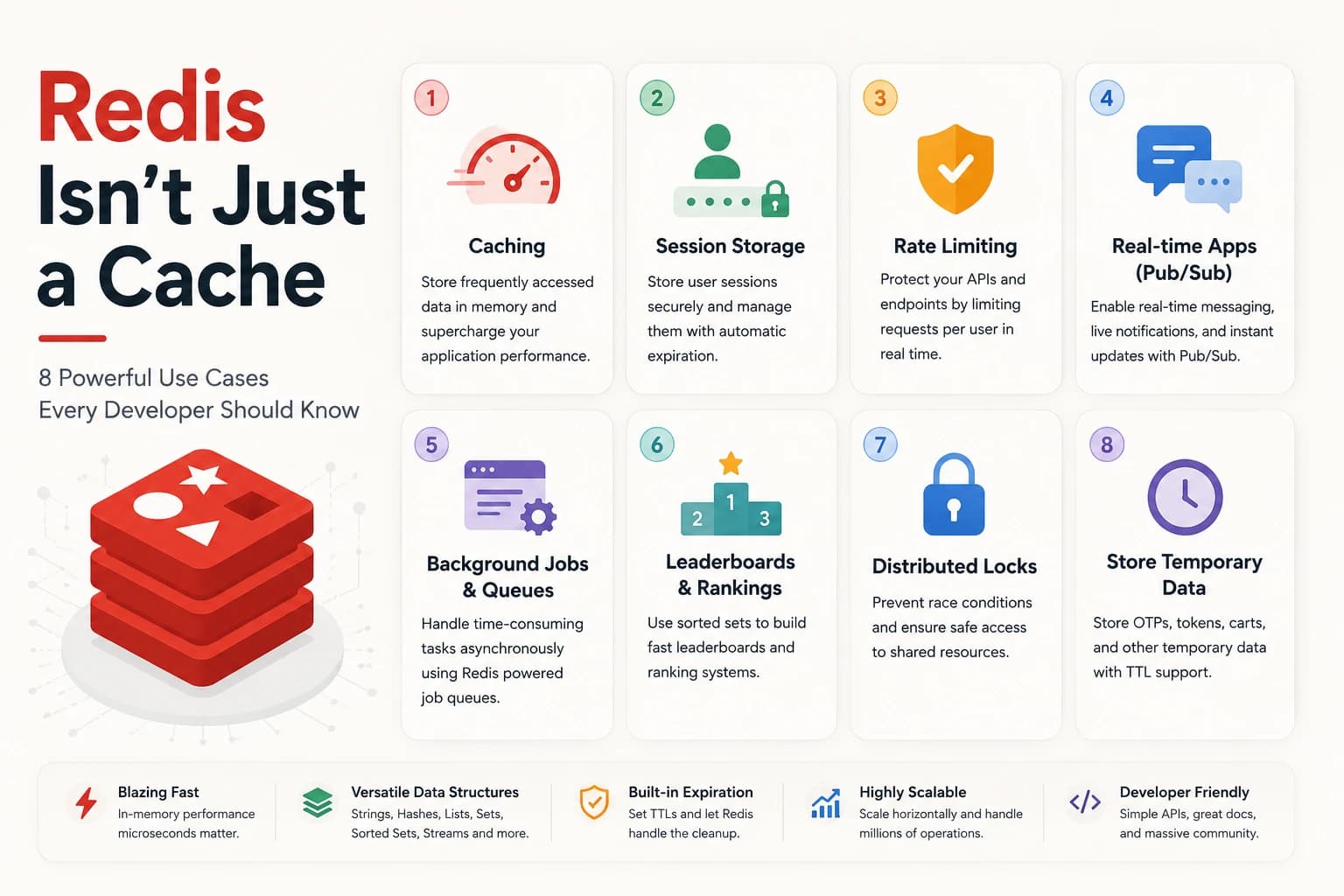
Redis Isn't Just a Cache: 8 Powerful Ways to Use Redis in Modern Applications
When developers first hear about Redis, the first thing that usually comes to mind is caching. While Redis is one of the fastest caching solutions available, limiting it to just that would be overlooking its true potential.
Redis is an in-memory data store capable of handling millions of operations per second. Its rich set of data structures and lightning-fast performance make it an essential tool for building scalable, real-time applications.
From authentication systems to chat applications and background job processing, Redis powers some of the world's largest platforms.
Let's explore why Redis deserves a place in every backend developer's toolkit.
What Is Redis?
Redis (Remote Dictionary Server) is an open-source, in-memory data store that can be used as:
- Cache
- Database
- Message broker
- Session store
- Queue
- Real-time data store
Unlike traditional databases that primarily store data on disk, Redis keeps data in memory, making read and write operations incredibly fast.
This makes it ideal for data that needs to be accessed frequently or updated in real time.
1. Supercharge Your Application with Caching
The most common Redis use case is caching.
Imagine your application needs to fetch the same product list thousands of times every minute.
Instead of querying the database for every request, Redis stores the result in memory.
Benefits include:
- Faster response times
- Reduced database load
- Better scalability
- Lower infrastructure costs
Caching is often the quickest way to improve application performance.
2. Store User Sessions
When users log in, their session information needs to be stored somewhere.
Redis is perfect because it's:
- Fast
- Temporary
- Highly available
- Easy to expire automatically
Instead of storing session data in your primary database, Redis can manage active sessions efficiently.
3. Implement Rate Limiting
Public APIs need protection against abuse.
Redis makes implementing rate limiting simple.
Examples include:
- Maximum 100 requests per minute
- Login attempt limits
- Password reset limits
- OTP request limits
This helps protect your application from spam, brute-force attacks, and excessive traffic.
4. Power Real-Time Applications
Redis supports Pub/Sub (Publish/Subscribe), making it ideal for real-time systems.
Common use cases include:
- Chat applications
- Live notifications
- Multiplayer games
- Real-time dashboards
- Stock market updates
Instead of constantly polling the server, applications receive updates instantly.
5. Build Background Job Queues
Not every task should happen during an API request.
For example:
- Sending emails
- Processing images
- Generating PDFs
- Video transcoding
- Sending notifications
These tasks can be added to a queue and processed asynchronously.
Popular libraries like BullMQ use Redis to power reliable job queues.
6. Leaderboards and Rankings
Redis provides sorted sets, making ranking systems extremely efficient.
Examples include:
- Gaming leaderboards
- Top-selling products
- Most active users
- Trending posts
- Live competition rankings
Instead of writing complex SQL queries, Redis retrieves rankings almost instantly.
7. Distributed Locks
When multiple servers access the same resource simultaneously, race conditions can occur.
Redis can act as a distributed lock manager, ensuring that only one process modifies a resource at a time.
This is useful for:
- Payment processing
- Inventory management
- Scheduled tasks
- Order creation
Proper locking helps prevent duplicate operations and inconsistent data.
8. Store Temporary Data
Some information only needs to exist for a short period.
Examples include:
- OTP codes
- Password reset tokens
- Email verification links
- Temporary shopping carts
- API access tokens
Redis allows keys to expire automatically using a Time To Live (TTL), eliminating the need for manual cleanup.
Why Developers Love Redis
Redis offers several advantages that make it a favorite among backend engineers:
- Extremely fast in-memory performance
- Rich data structures (Strings, Lists, Sets, Hashes, Sorted Sets, Streams)
- Automatic key expiration
- Easy horizontal scaling
- Broad language support
- Excellent integration with modern frameworks
Whether you're building a startup MVP or a high-traffic enterprise application, Redis can significantly improve both performance and scalability.
Common Mistakes When Using Redis
Redis is powerful, but it's important to use it wisely.
Avoid these common mistakes:
- Using Redis as a permanent database without persistence.
- Forgetting to set expiration times for temporary data.
- Storing very large objects unnecessarily.
- Ignoring memory limits and eviction policies.
- Caching data that changes too frequently.
Understanding your workload helps you get the most out of Redis.
When Should You Use Redis?
Redis is an excellent choice when your application needs:
- Fast data access
- Session management
- Caching
- Background job processing
- Rate limiting
- Real-time messaging
- Temporary storage
- High-performance leaderboards
It's not a replacement for your primary database—but it works exceptionally well alongside databases like PostgreSQL, MySQL, and MongoDB.
Final Thoughts
Redis is much more than a cache. It's a versatile tool that solves a wide range of performance and scalability challenges in modern applications.
As your projects grow and user traffic increases, you'll quickly discover that reducing database load, processing background jobs efficiently, and delivering real-time experiences are essential for building production-ready software.
Learning Redis early in your backend journey will help you design faster, more resilient, and more scalable applications—skills that every modern full-stack developer should have.