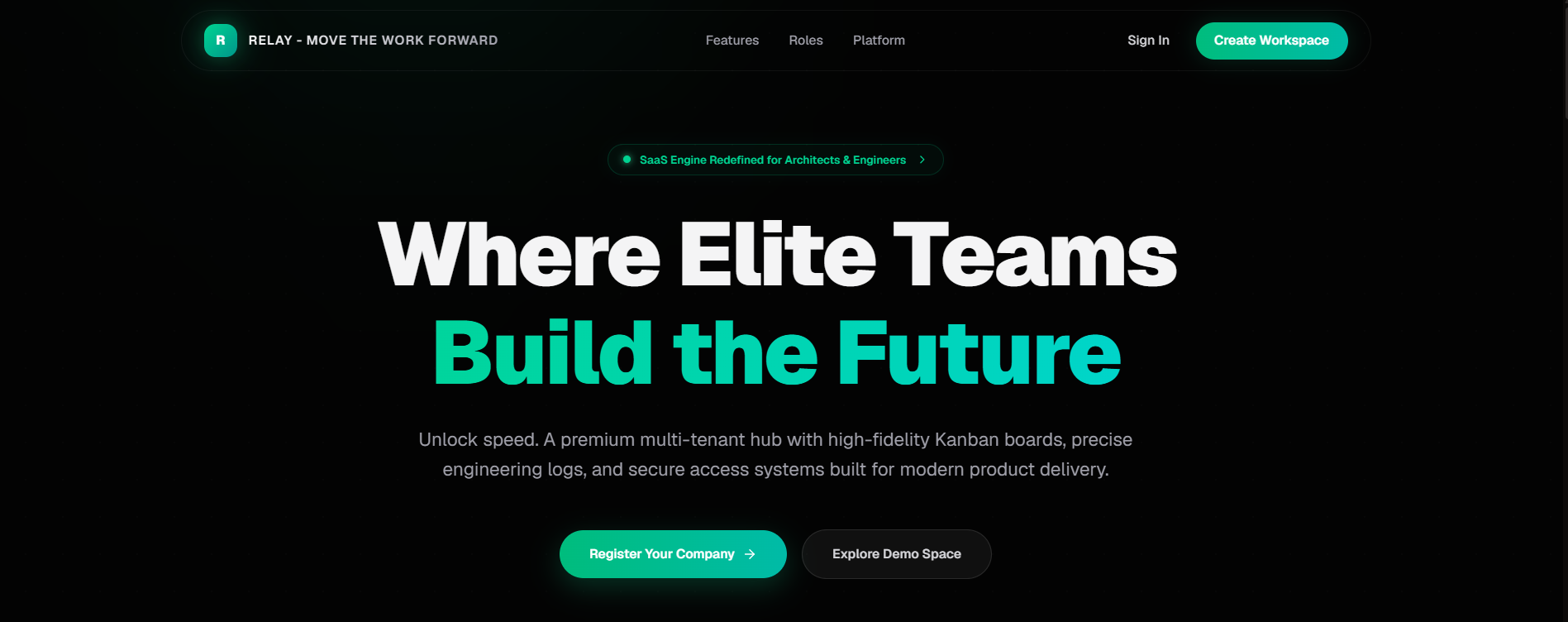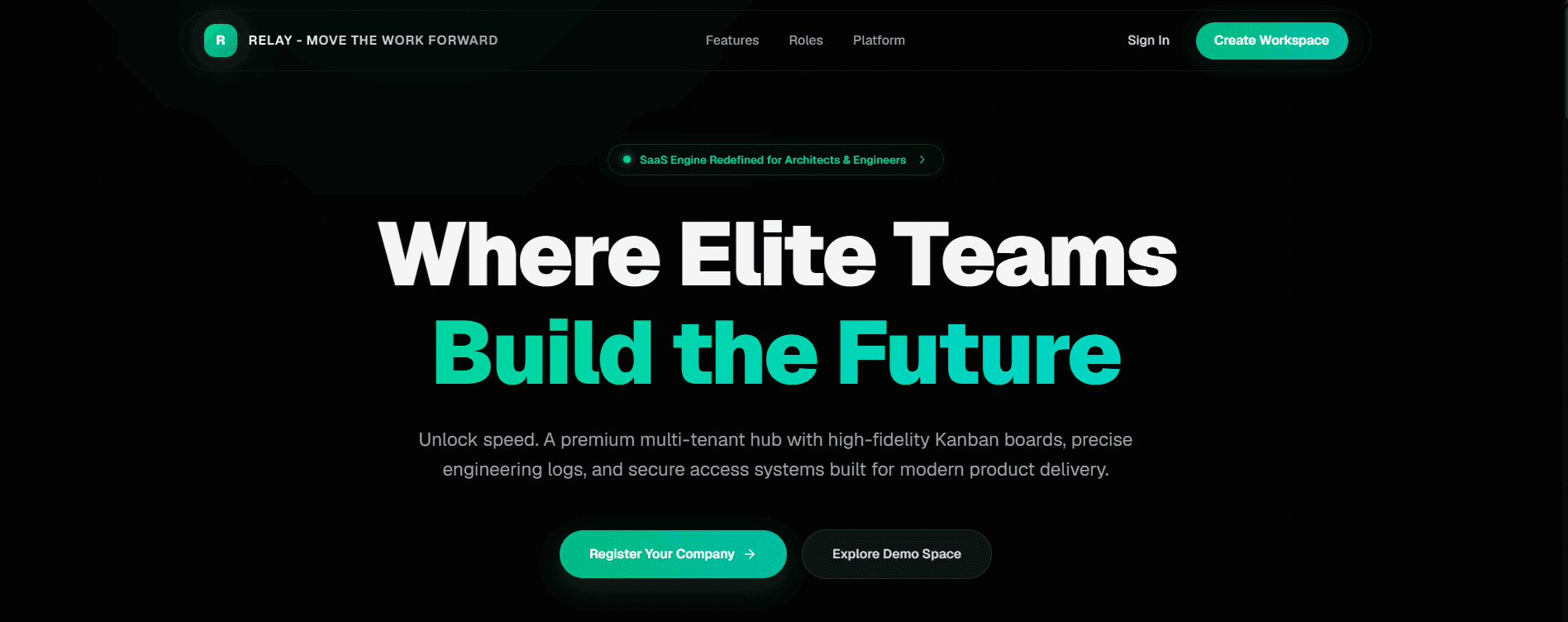
Replaces fragmented project management workflows by providing engineering teams with a single, multi-tenant platform that unifies task tracking, sprint management, real-time team discussions, time logging, client communication, file management, and productivity analytics — all governed by role-based access control and a comprehensive audit trail.
Overview
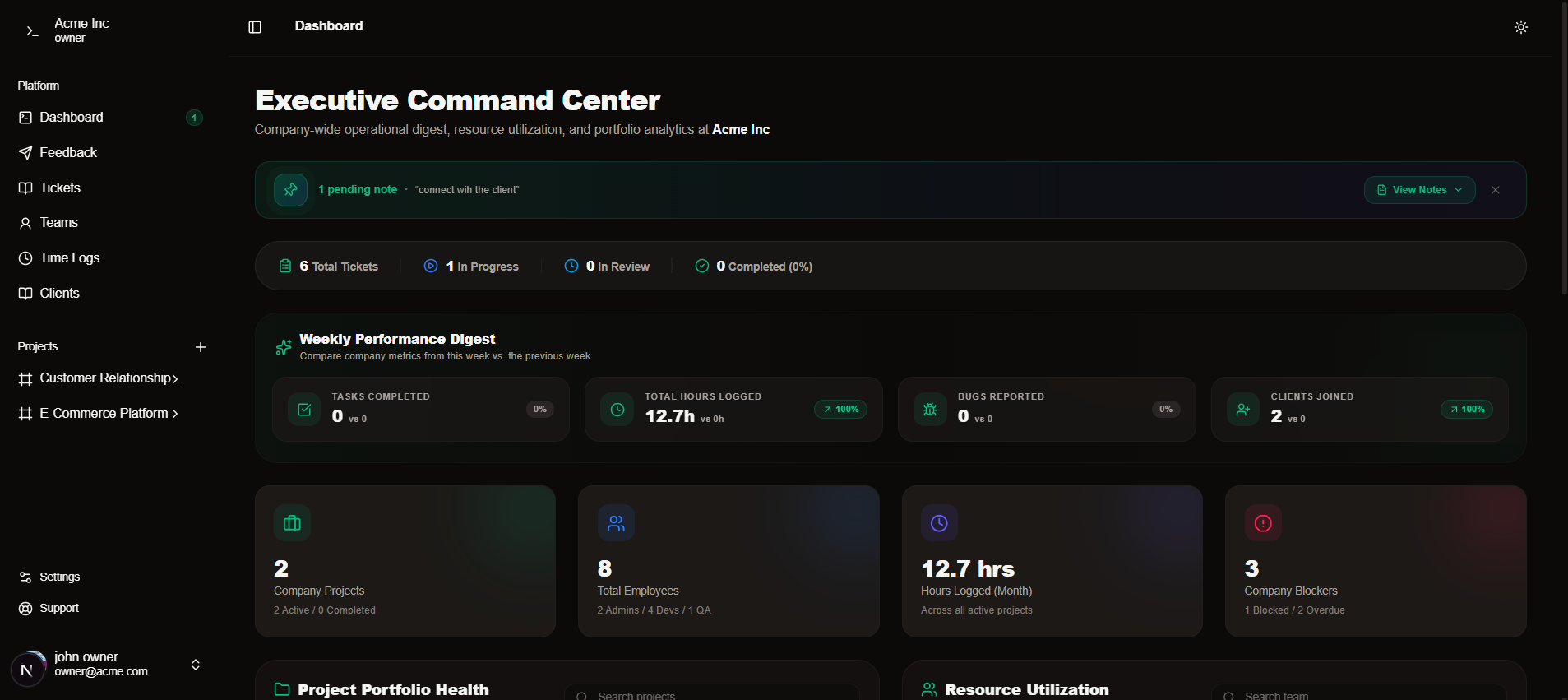
RELAY is a full-featured, multi-tenant project management SaaS platform designed from the ground up for engineering teams, agencies, and product companies. Each organization registers its own dedicated workspace (Company), then invites team members, manages projects, and tracks every aspect of the software development lifecycle from a single, unified dashboard.
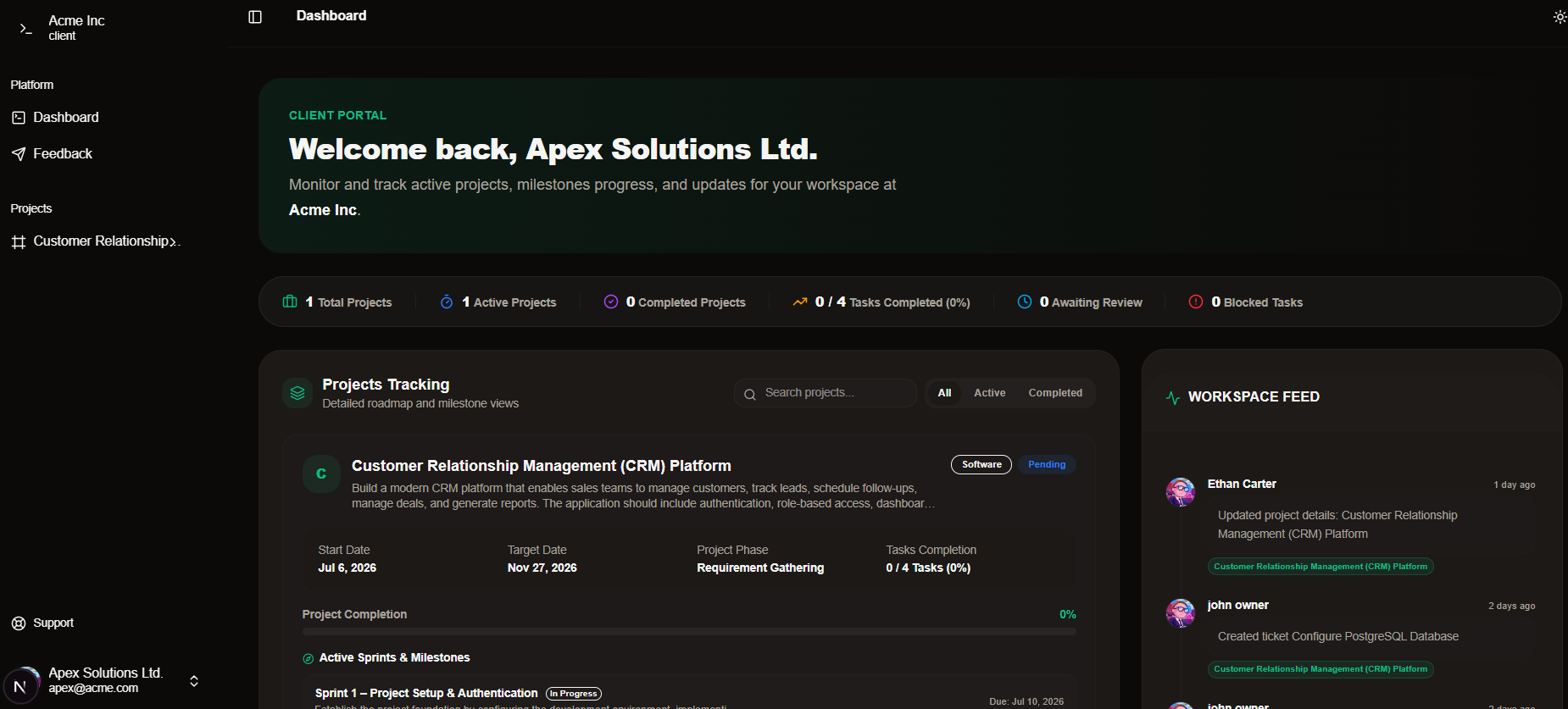
The platform implements a robust Role-Based Access Control (RBAC) system with five distinct roles — Owner, Admin, Member, QA, and Client — each with tailored dashboards, permissions, and UI surfaces. Owners have full workspace control including billing and settings; Admins manage teams, projects, clients, and generate reports; Members focus on assigned tasks and time logging; QA engineers review and validate work; and Clients receive a dedicated read-only portal to monitor project progress and provide feedback.
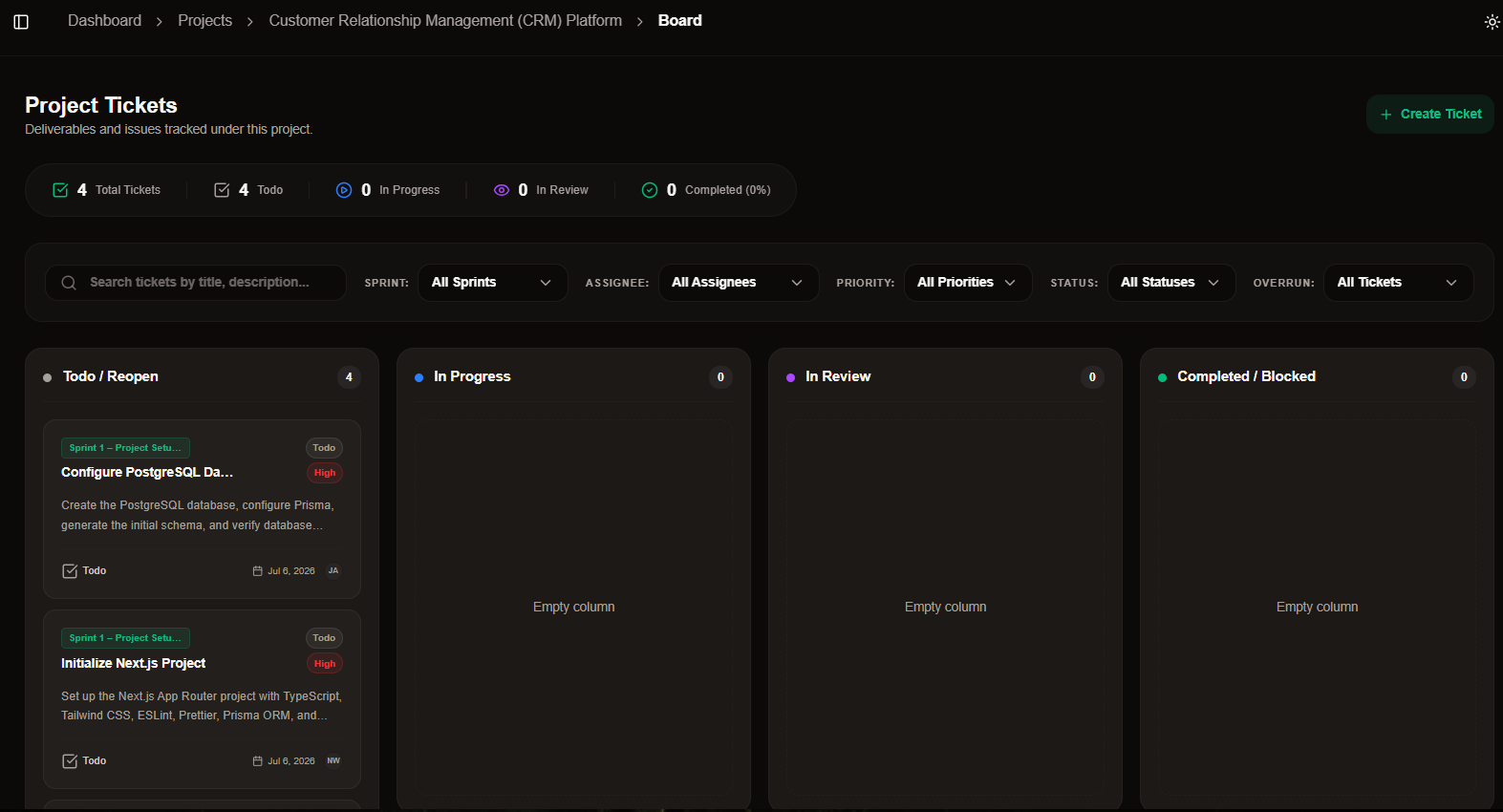
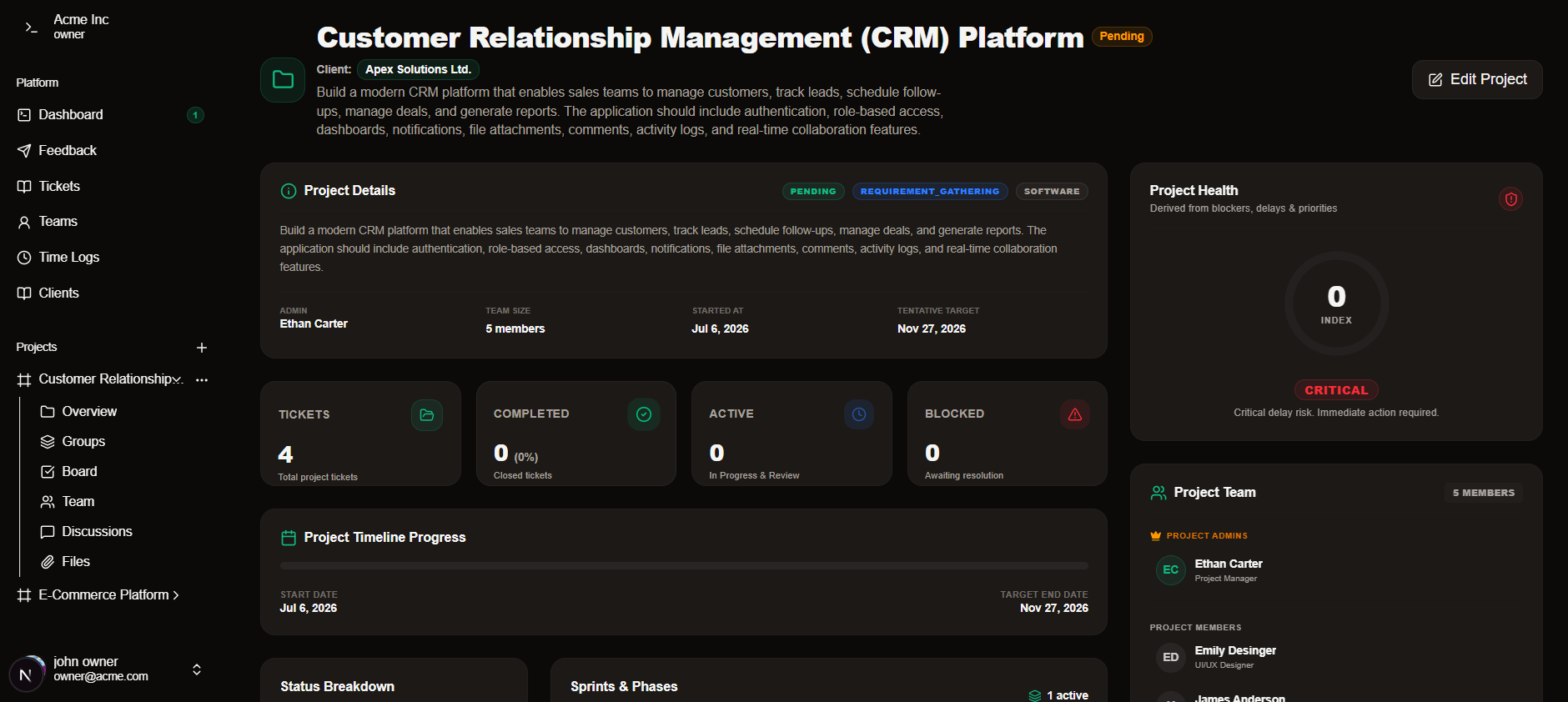
Projects are organized into configurable groups — Sprints, Phases, Milestones, or custom sections — enabling teams to follow Agile, Waterfall, or hybrid methodologies. Within each project, granular Tickets (supporting types like Feature, Bug, Task, Improvement, and Documentation) flow through a comprehensive status pipeline: Pending → In Progress → In Review → Completed (with Blocked, Reopen, and Backlog states). An interactive drag-and-drop Kanban board (powered by @dnd-kit) lets users move tickets between columns with optimistic UI updates. Every status transition to Blocked or Reopen requires a mandatory reason, creating a full audit trail with TicketReason history.
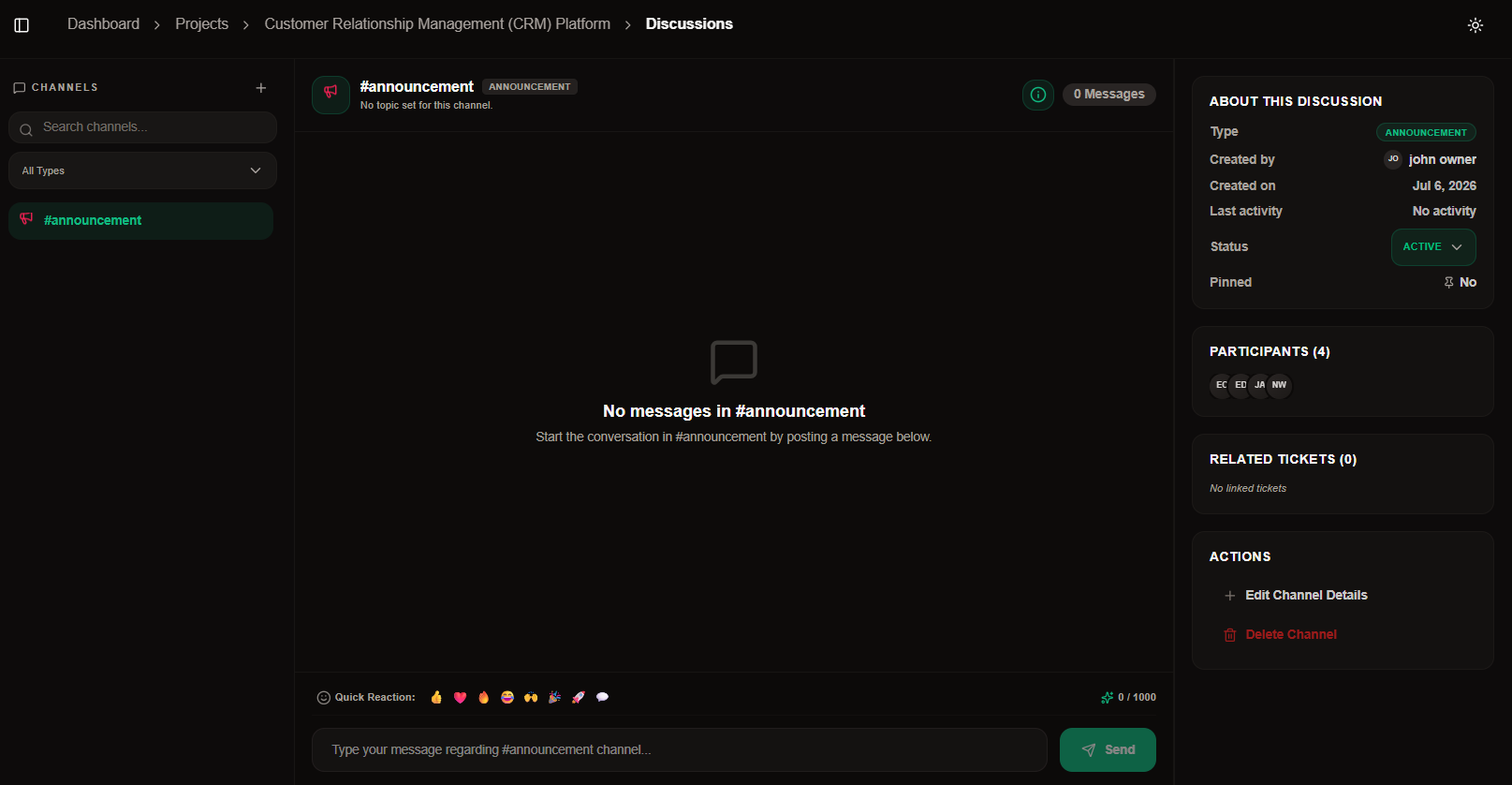
Real-time collaboration is powered by Ably, enabling live discussion channels within projects. Users can create categorized Discussion Groups (General, Suggestion, Question, Announcement, Decision, Complaint, Feedback, Improvement) with real-time messaging, member tagging, ticket linking, and channel pinning/archiving — essentially a project-scoped Slack-like experience.
Advanced Time Tracking allows any team member to log work hours against specific tickets or projects, with start/end timestamps, duration calculations, and optional descriptions. The Time Logs view provides comprehensive filtering by user, project, ticket, and date range — with visual comparisons of estimated vs. actual hours to spot scope creep early.
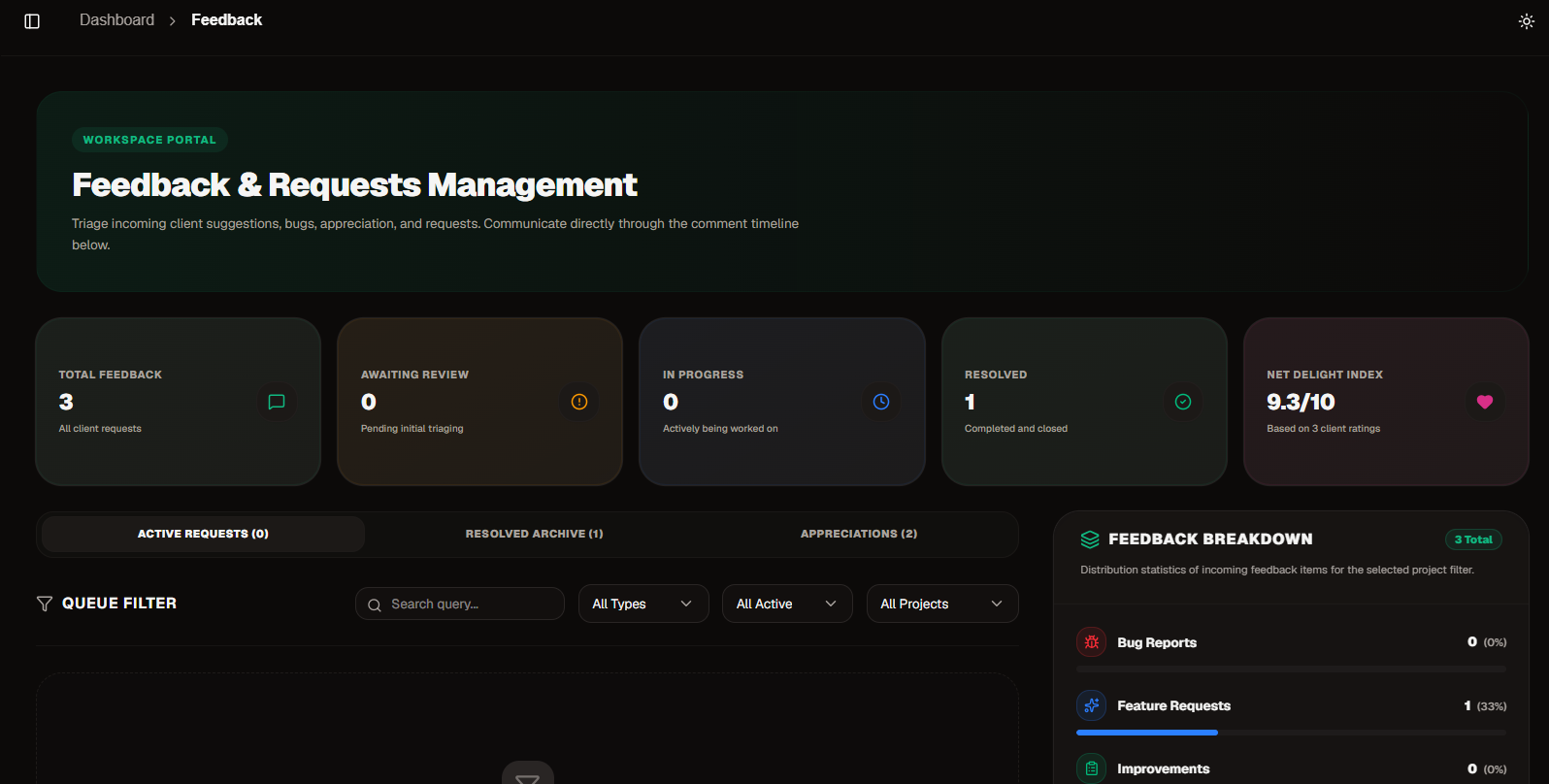
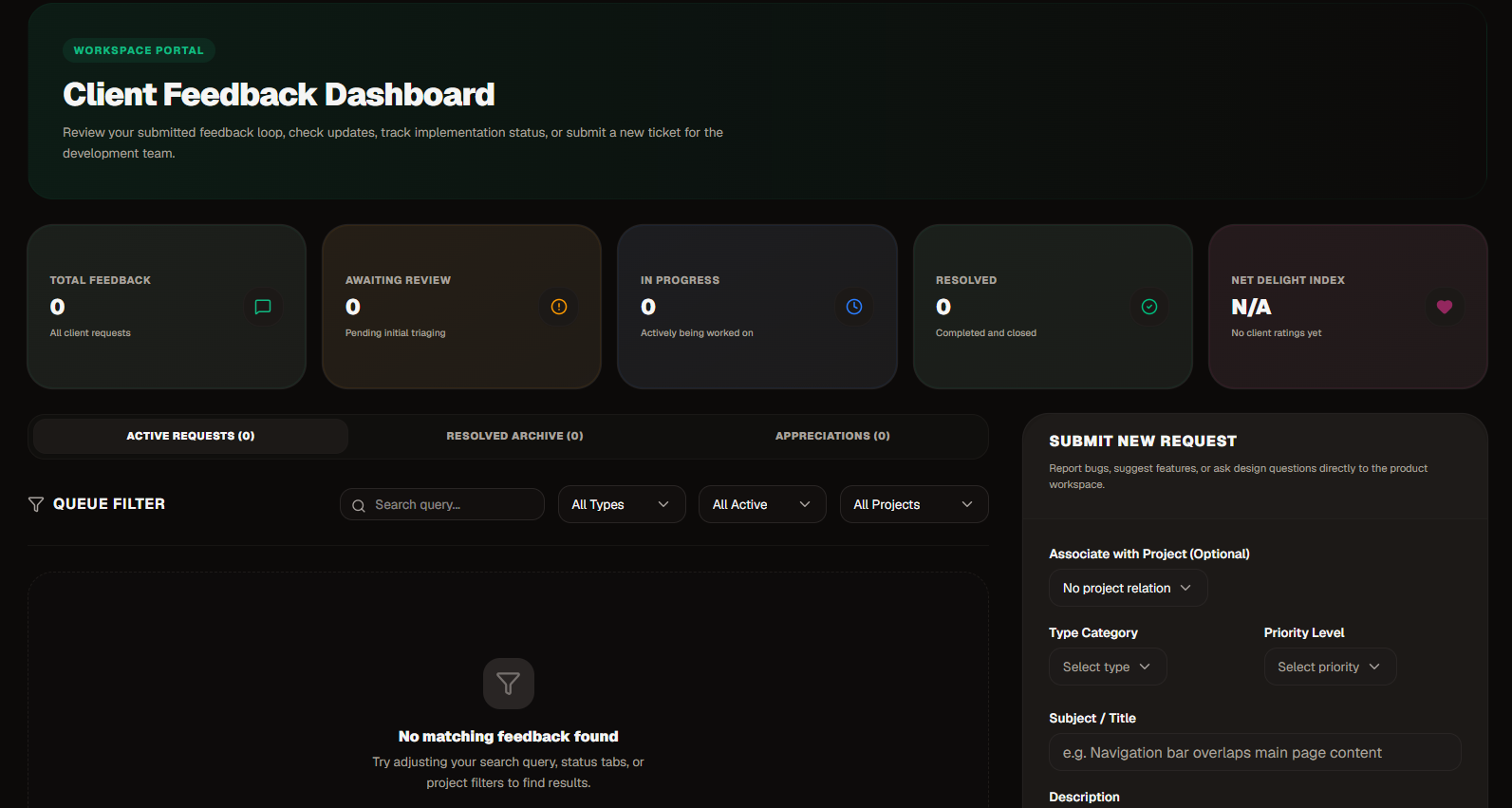
The platform also includes a robust Feedback System where clients and admins can submit categorized feedback (Bug, Feature Request, Improvement, Question) with priority levels and status tracking. Feedback threads support comments, enabling back-and-forth discussion between the team and stakeholders.
File management is built-in, allowing team members to upload attachments to tickets with full metadata tracking (uploader, timestamp, file type detection). The Project Files tab aggregates all attachments across tickets for a unified file browser experience.
User profiles feature detailed activity history, productivity analytics, designation management (across Software, Marketing, Design, and Management categories), and project assignment tracking. A guided onboarding flow walks new workspace owners through company setup, and a secure invite system (with auto-generated credentials and email notifications via Nodemailer) streamlines team growth.
Built with Next.js 16 (App Router, Server Components), Prisma ORM with PostgreSQL, Supabase for authentication and storage, Redux Toolkit for state management, TanStack React Query for server-state caching, and a modern Radix UI + Shadcn UI component system with full dark mode support — the platform delivers a polished, enterprise-grade experience.
Technologies Used
Key Highlights
- Multi-tenant workspace architecture with dedicated company onboarding flow
- 5-tier Role-Based Access Control (Owner, Admin, Member, QA, Client) with tailored dashboards and permission gates
- Interactive drag-and-drop Kanban board powered by @dnd-kit with optimistic UI updates
- Configurable project grouping — Sprints, Phases, Milestones, Campaigns, or custom sections for Agile, Waterfall, or hybrid workflows
- Comprehensive ticket lifecycle management with 7 statuses (Pending, In Progress, In Review, Completed, Blocked, Reopen, Backlog) and 6 types (Feature, Bug, Task, Improvement, Documentation, Other)
- Mandatory Blocked/Reopen reason tracking with full audit trail (TicketReason history)
- Real-time project discussion channels powered by Ably — categorized groups (General, Suggestion, Question, Announcement, Decision, Complaint, Feedback, Improvement) with live messaging, member management, ticket linking, and channel pinning/archiving
- Advanced time tracking with start/end timestamps, duration logging, estimated vs. actual hour comparisons, and multi-filter views (by user, project, ticket, date range)
- Comprehensive feedback system with categorized submissions (Bug, Feature, Improvement, Question), priority levels (Low, Medium, High, Critical), status tracking, and threaded comment discussions
- Project-level file management — ticket attachments with file type detection, uploader tracking, and aggregated project file browser
- Rich ticket detail drawers with inline description editing, comment threads, attachment uploads, time log management, and reason history
- Full team management with member invitation, role assignment, designation selection (50+ designations across Software, Marketing, Design, Management), project assignment, and activity monitoring
- Dedicated client portal with read-only project access, progress monitoring, team visibility, and feedback submission
- Project lifecycle phases (Idea → Discovery → Requirements → Prototype → Planning → Design → Development → Testing → Review → Deployment → Maintenance → Completed)
- Detailed project overview with PieChart analytics (Recharts), sprint progress tracking, team composition, and activity feeds
- Secure authentication with JWT/Jose cookie-based sessions, bcrypt password hashing, and forced password change on first invite login
- Dynamic breadcrumb navigation, theme switching (light/dark mode via next-themes), and responsive sidebar layout
- Comprehensive activity logging for audit trails — tracks project, group, ticket, member, role, comment, and file events with JSON metadata
- Guided workspace onboarding with multi-step company creation flow
- Email notification system via Nodemailer for team invitations and updates
Challenges Faced
Challenge 1: Implementing granular Role-Based Access Control across 5 user tiers with different dashboard experiences, API-level permission gates, and dynamic UI rendering based on user roles. Solution: Built a centralized requireRole() middleware that verifies JWT tokens and fetches fresh roles from the database on every API call, ensuring dynamic role updates (e.g., after workspace creation) are immediately enforced. On the frontend, role-aware sidebar navigation, conditional component rendering, and route-level guards provide a seamless, tailored experience for each user type. Challenge 2: Managing complex state synchronization between server data, client cache, and real-time updates across Kanban boards, discussion channels, and team views. Solution: Adopted a hybrid state management strategy — Redux Toolkit for global client state (user session, active tab), TanStack React Query for server-state caching with automatic background refetching and optimistic updates, and Ably Realtime for pub/sub messaging in discussion channels. Kanban drag-and-drop operations use optimistic UI updates with rollback on server errors. Challenge 3: Designing a flexible project grouping system that supports Agile sprints, Waterfall phases, milestones, campaigns, and custom sections within a single unified schema. Solution: Created a polymorphic ProjectGroup model with a configurable ProjectGroupType enum (sprint, phase, section, milestone, campaign_stage, custom) and independent GroupStatus lifecycle, allowing teams to organize work using whatever methodology fits their process — all backed by the same relational structure and UI components.
Key Learnings
Designed and built a scalable multi-tenant SaaS architecture with Next.js 16 App Router and Server Components, implemented granular RBAC with 5 permission tiers and dynamic route-level authorization, integrated Ably for real-time discussion channels with token-based authentication, built interactive drag-and-drop Kanban boards with @dnd-kit and optimistic state reconciliation, managed complex server-client state synchronization using Redux Toolkit + TanStack React Query, designed a normalized PostgreSQL schema with 14+ relational models using Prisma ORM, implemented secure JWT cookie-based authentication with Jose, and delivered a premium dark-mode UI using Radix UI + Shadcn UI + Tailwind CSS v4.
Future Scope
• Bidirectional calendar integration (Google Calendar / Outlook) • AI-powered productivity assistant and smart task suggestions • Offline mode with conflict-free synchronization (CRDTs) • Recurring task templates and automation rules • Cross-platform desktop application (Electron/Tauri) • Gantt chart and timeline visualization for project planning • Advanced reporting dashboard with exportable PDF/CSV analytics • GitHub/GitLab Integration • Resource allocation and capacity planning views • Mobile companion app (React Native)
PROJECT SCREENSHOTS
Explore the user interfaces, database schemas, responsive dashboards, and core features of RELAY.